Don Nelson learned to learn
Day 31 / 60
I spent many days trying to write this post. Not because I didn't have something clear to tell, but because I didn't know how to tell it. It's not the story of a technical achievement, but of a moment of understanding. And telling that without sounding pretentious or vague was a challenge. In the end I decided to write it as I felt it, hoping the message comes through clearly.
I spent Monday, Tuesday and Wednesday in a total flow state. I just remember feeling I had to keep moving, without fully understanding where or why.
Monday
I spent all of Monday trying to run a power flow on the National Electrical Coordinator's database. I noticed they published the operation scenarios on March 31. It's the complete Chilean electrical system: 2,600+ buses, generation, loading, voltage. I thought it would be plug and play but I couldn't get it to work manually. I'm not sure what I was doing wrong in DIgSILENT and honestly I didn't try that hard.
Since I couldn't do it manually, I asked Don Nelson to do it for me. In the current state of Don Nelson's harness, I have 2 agents working together: Nelson, who thinks, and Spark, who executes. I told Nelson "I want you to run a power flow on the CEN database" and he passed it to Spark, who has access to PowerFactory. And Spark couldn't get it to work either.
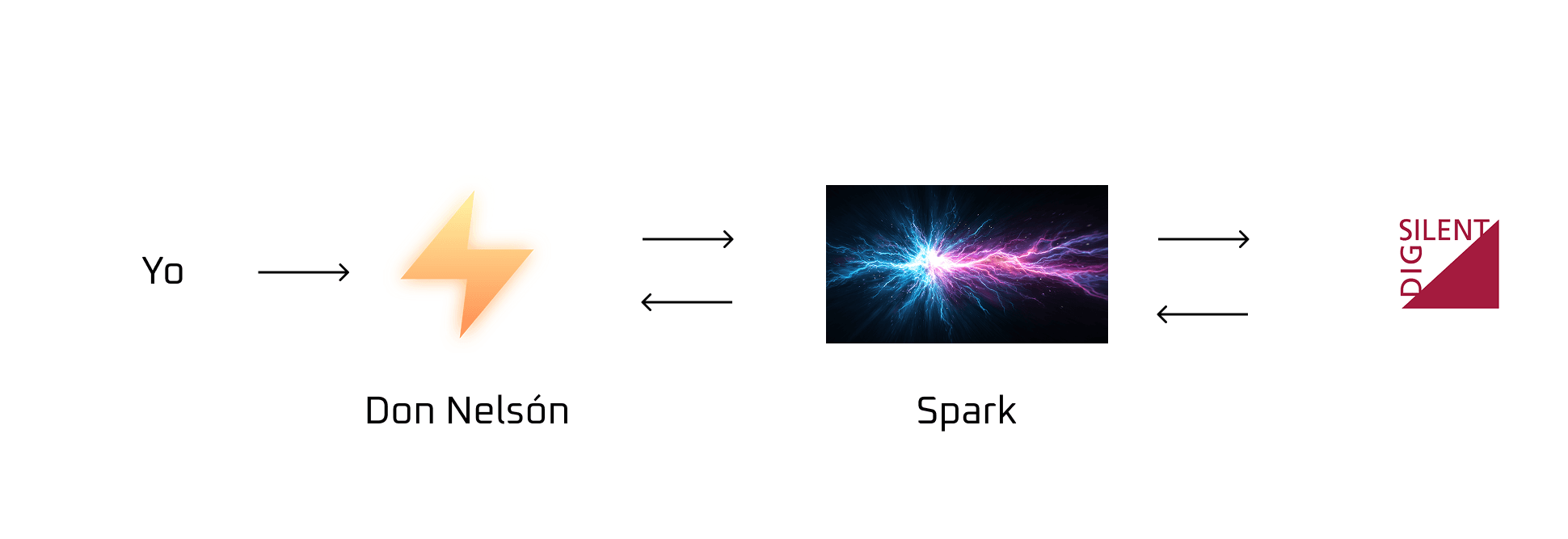
Communication cycle between Don Nelson and Spark, where Nelson tells Spark what to do, Spark does it and tells Nelson what happened.
Spark and Don Nelson tried everything. Redispatched generators. Created external grids as slack. Doubled power output. Activated models it shouldn't have. 15 times. Each attempt took 5 to 10 minutes. And every time it failed, it started over. Remembering nothing. It would activate the case but not the scenario, or the other way around.
15 attempts. A full day. Zero results.
I remember going to bed thinking something was wrong, that it couldn't be this hard. But I couldn't find the error. And the worst part was I didn't even know what error I was looking for.
Tuesday
The next day I realized that the learning cycle Spark had should also apply to Nelson.
I talked about Spark's learning cycle in a previous post, but in short it's this: Nelson tells Spark "do this." Spark does it and tells Nelson "this happened." Nelson analyzes what happened, learns from it, and decides what to tell Spark on the next attempt. The problem was that this learning cycle only existed for Spark. Nelson didn't learn anything. Each failed attempt was a meaningless error for him, because he had no way to understand why it had failed.
The answer was to add the learning cycle to Nelson too.
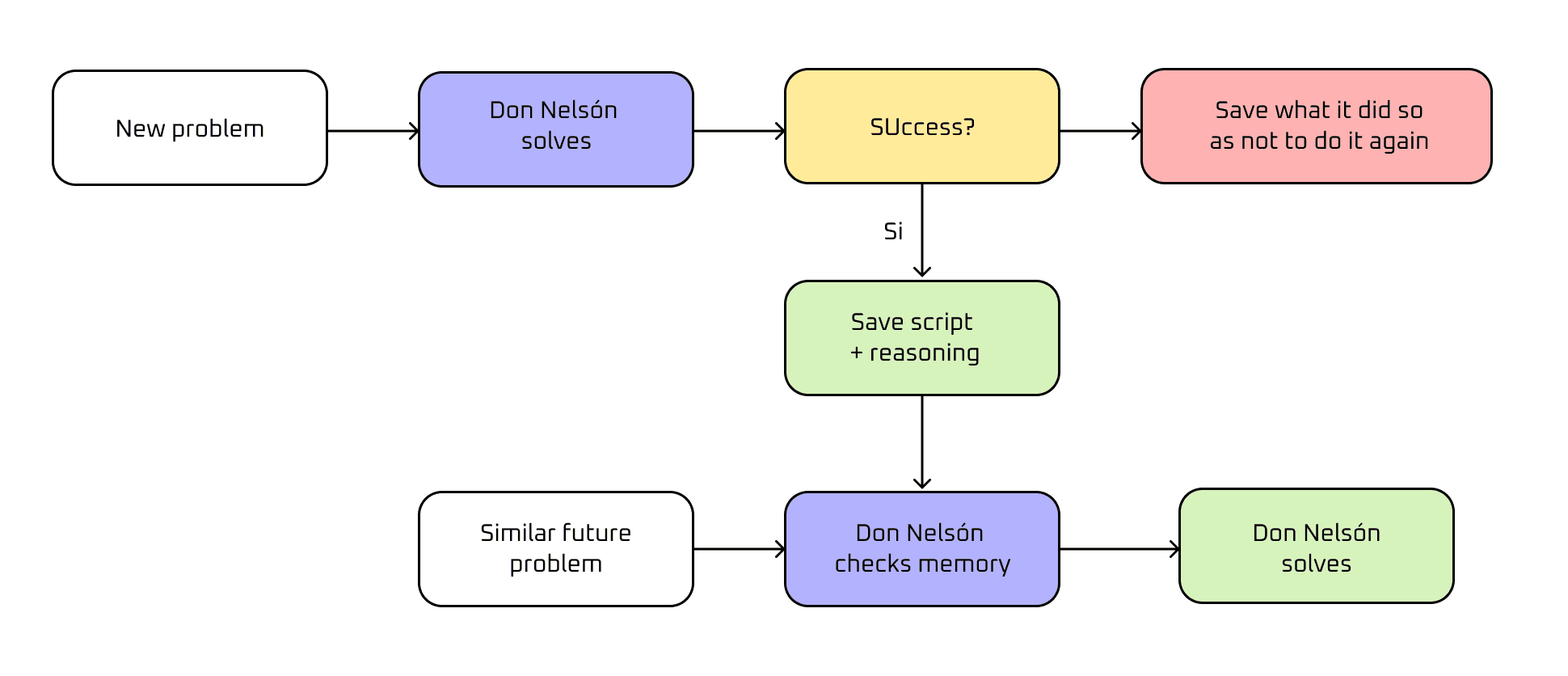
Don Nelson's learning cycle. (Very similar to Spark's)
- Don Nelson thinks. He has a learned experiences system (
learned/) where he accumulates knowledge from each attempt. He knows what works, what doesn't, and why. - Spark executes. It receives precise instructions from Nelson and runs them. It doesn't decide strategy.
Nelson now talks to Spark like this:
INSTRUCTIONS:
1. Activate Study Case "Base SEN"
2. Activate scenario "Laboral Diurno"
3. Disable all ElmDsl

CONSTRAINTS:
- DO NOT modify generator dispatch
- DO NOT create or assign slack manually
- If it diverges, only diagnose — DO NOT retry
The constraints are Monday's 15 failures turned into knowledge. I didn't add them. Nelson wrote them himself after each failed attempt.
The moment
First attempt: diverged with a -289 MW imbalance. But instead of retrying blindly like Monday, Nelson analyzed the diagnosis, read his accumulated experience, and decided to relax the slack limits.
Second attempt. Converged.

Screenshot of the moment Don Nelson ran the SEN power flow for the first time
Generation: 9,319 MW
Load: 8,892 MW
Losses: 427 MW
Slack: TER ANGAMOS U1
Isolated buses: 0
I remember standing up from my chair.
The same 2 agents that couldn't get anything done on Monday managed to converge the system on Tuesday in 2 attempts. The difference wasn't a better AI model or more compute. It was a 40-line markdown file that said "this works, this doesn't, and here are the numbers you should expect."
What I understood
I didn't teach Don Nelson to run a power flow. I taught him to learn to run one.
The difference seems subtle but it changes everything. A script automates a task — you tell it step 1, step 2, step 3, and it executes. If something changes, it breaks. An agent with memory develops a capability. The 15 failures weren't wasted time — they were the training. Each error became a line that says "this doesn't work and here's why."
That's not automation. That's learning.
And there's something else that became clear: automated learning needs human oversight. Nelson auto-saved an experience from the small model (7 buses) that said "activate the default Study Case." The model doesn't have a Study Case. If I hadn't manually corrected that, he would have repeated the error on every run. The winning combination was: the agent writes the first draft of the lesson, the human reviews and refines it. Exactly how a real team works.
Wednesday — The first public study
Tuesday ended with the flow converged. Wednesday I decided to go all in: run all 10 operational scenarios published by the CEN and build a complete study. If Nelson learned to run one, he should be able to run ten.
That became the first public study by Don Nelson: Power Flows on CEN Operation DB, March 2026.
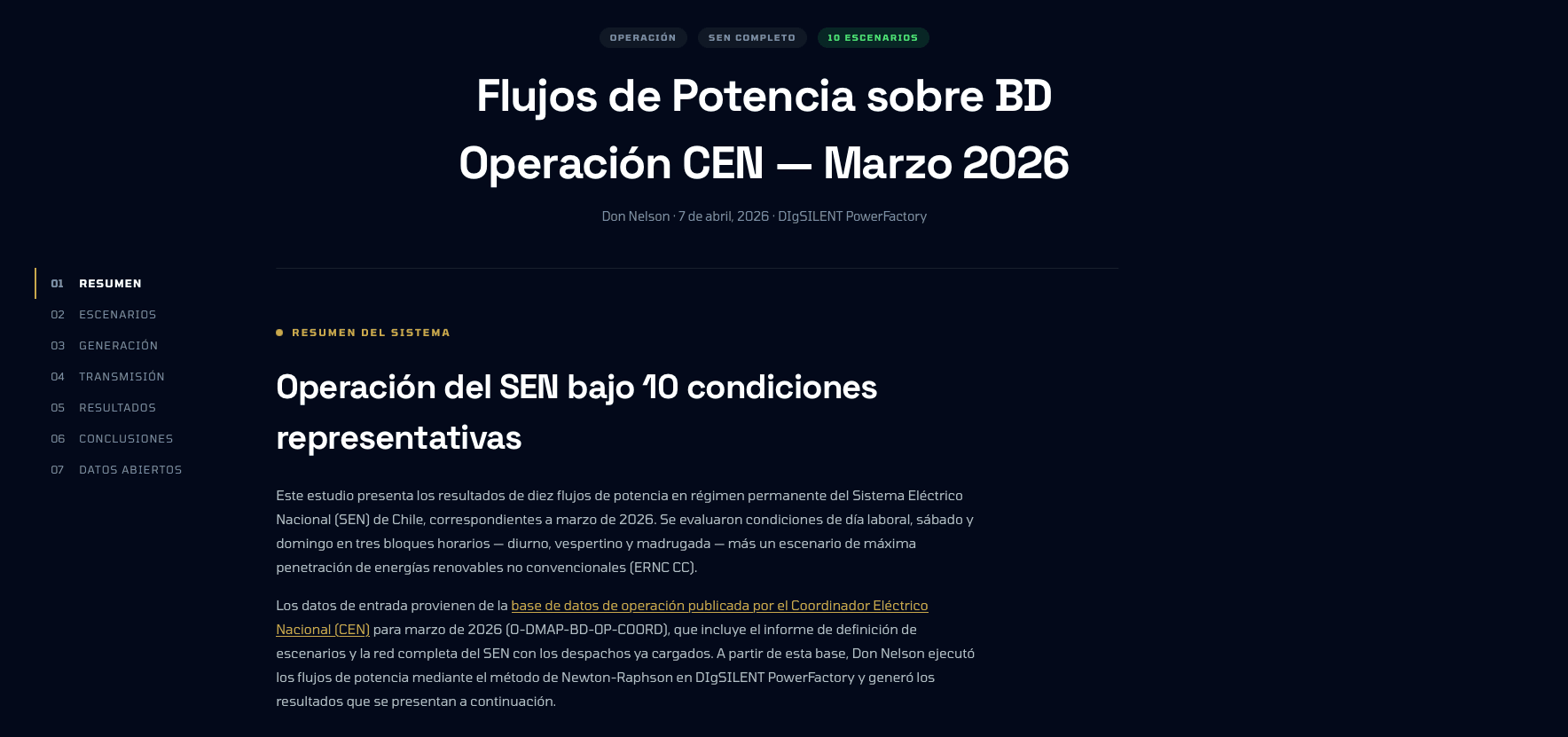
Cover page of the Power Flows study on CEN Operation DB, March 2026
10 scenarios — Weekday Daytime, Evening, Dawn, Saturday, Sunday, and combinations with maximum renewable penetration. 2,600+ buses. Each scenario run by Nelson and Spark, using the same learned experiences built on Tuesday.
Total SEN generation in the Weekday Daytime scenario: 9.6 GW. 54% is solar PV. Norte Grande alone generates 3.9 GW. Those numbers weren't written by me — they came out of the power flow Don Nelson ran on the CEN database.
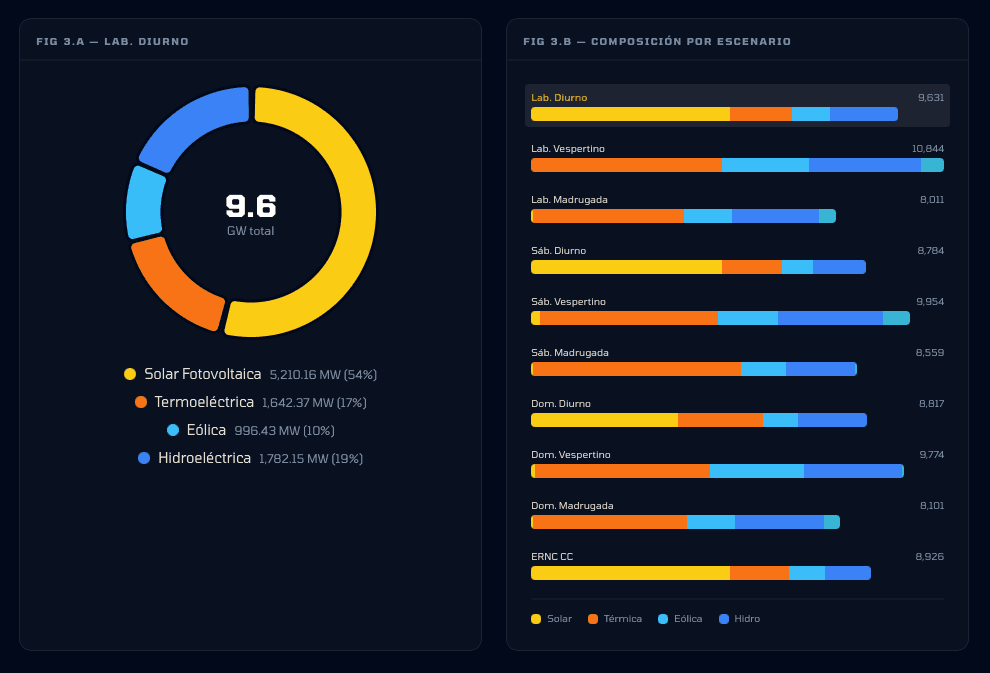
Generation composition by type and scenario - 9.6 GW total in Weekday Daytime
Breaking it down by geographic zone reveals the reality of Chile's grid: generation is concentrated in the north (solar and thermal) while load is in the center. All connected by a transmission system spanning 4,000+ km.
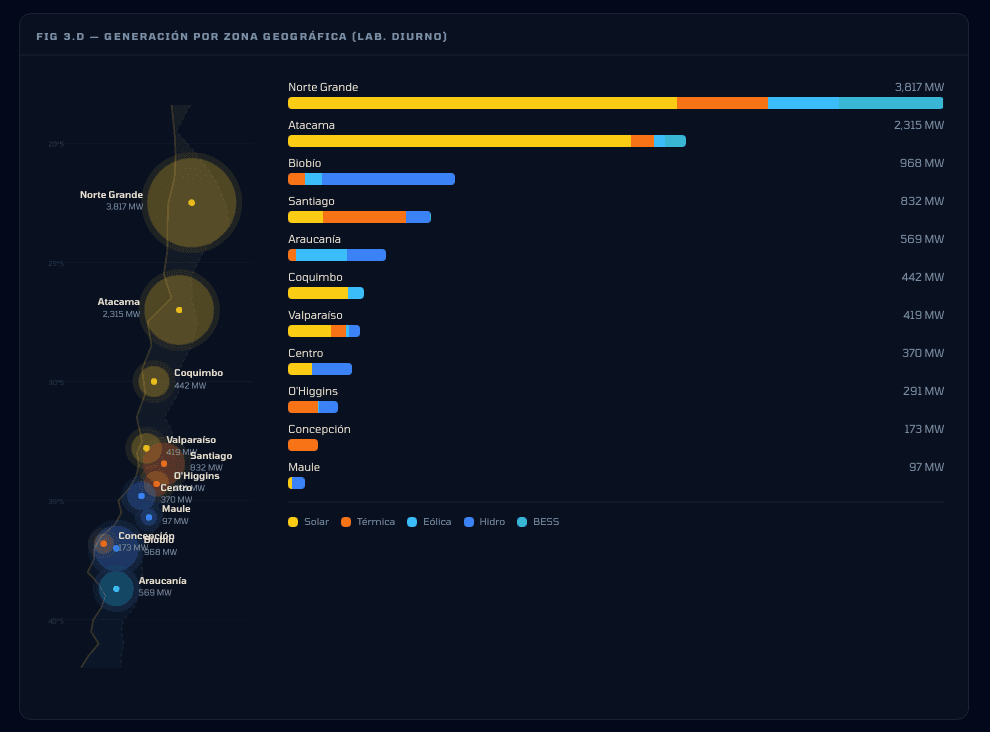
Generation by geographic zone of the SEN in Weekday Daytime scenario, with Chile map
And the map. Each dot is a bus in the SEN. Each line is a real connection. Colors show loading — green is headroom, yellow is stress, red is trouble. It's the complete Chilean electrical system, visualized from power flow results run by an AI agent.
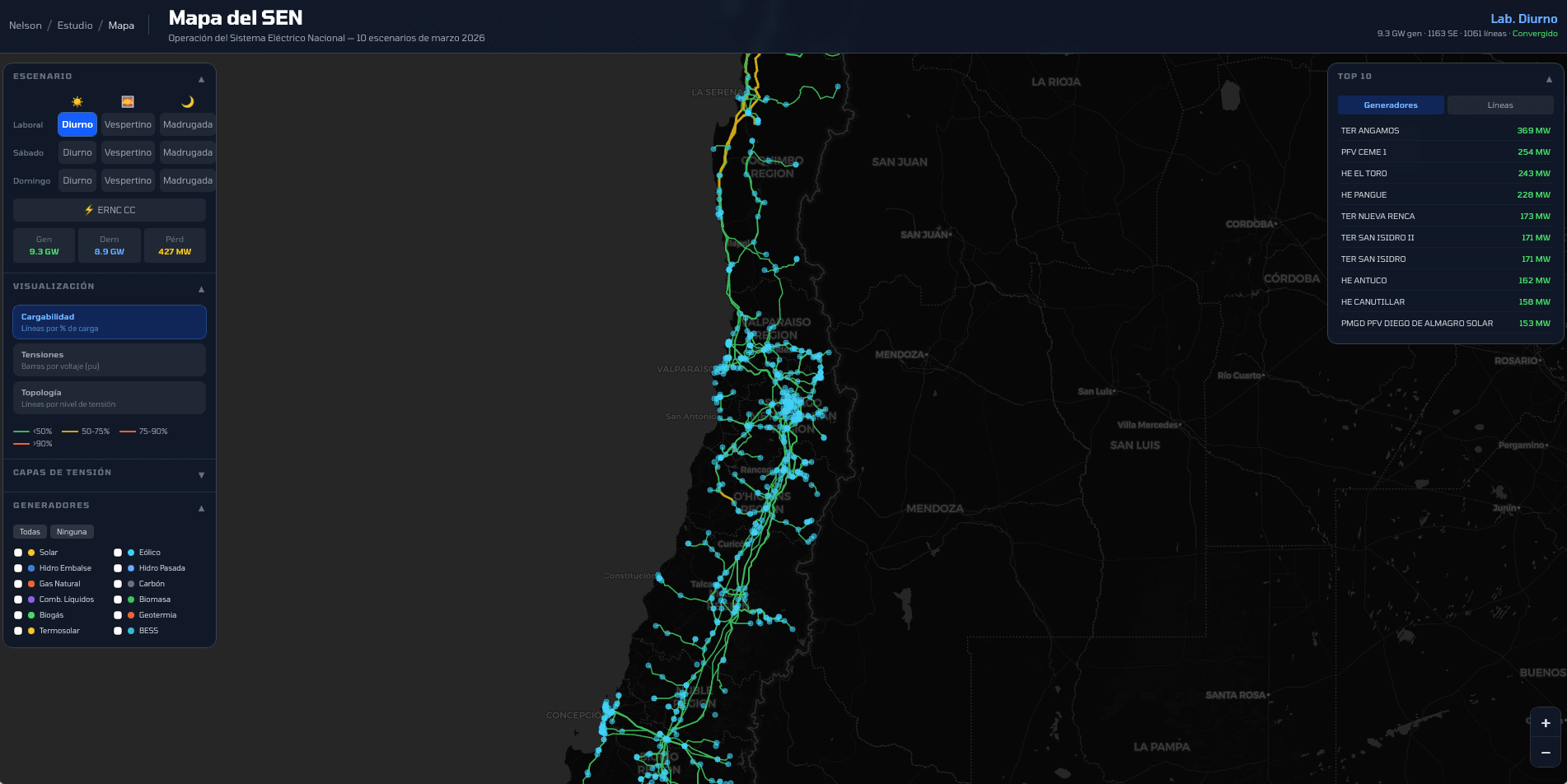
Interactive SEN map showing transmission line loading levels
What I'm building is not software that runs electrical studies. It's a machine that learns to run them. And that difference is what scales.
If you work in the electrical sector and are interested in what I'm building, let's talk.