Distilling knowledge for Don Nelson
There's one idea running through everything I've built: an agent's reliability doesn't live in the model, it lives in the harness. The model brings fluency. The harness brings knowledge, contracts and guardrails.
This post is about a key piece of that harness: the rules I distilled from the CEN's review history. Probably the most boring to explain, and the hardest to get. And along the way I'll take the chance to talk about the term that gives this post its name: distilling.
What does distilling knowledge mean?
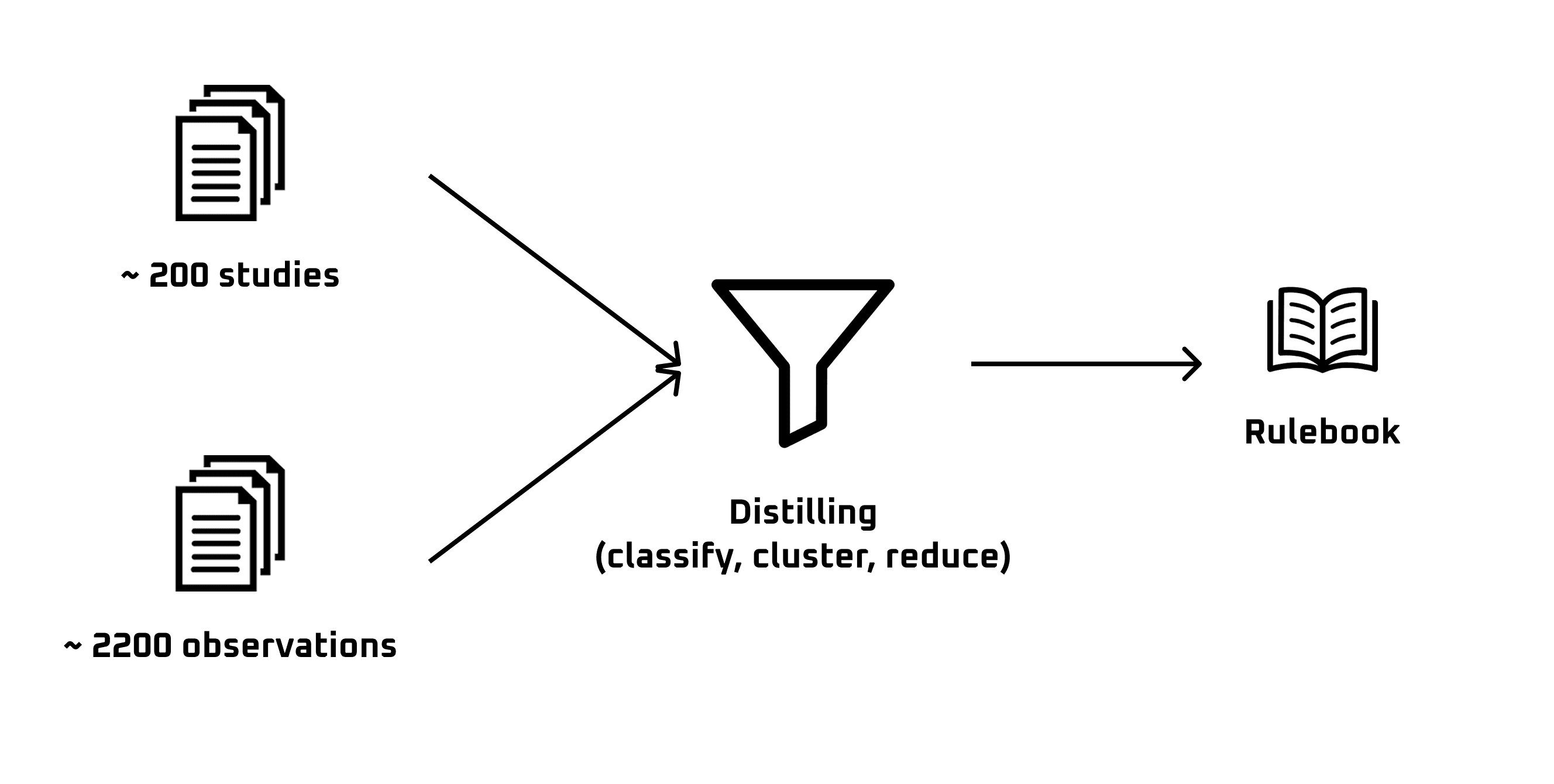
In chemistry, distilling means heating a mixture to separate out and keep only what matters. Same thing here: take 2,168 real observations — repeated, phrased a thousand different ways, mixed with paperwork — and boil them down to the 48 rules underneath. That judgement existed, but as tacit knowledge: it lived in reviewers' heads, scattered across thousands of PDFs. Distilling it makes it explicit — something you can read, run and measure.
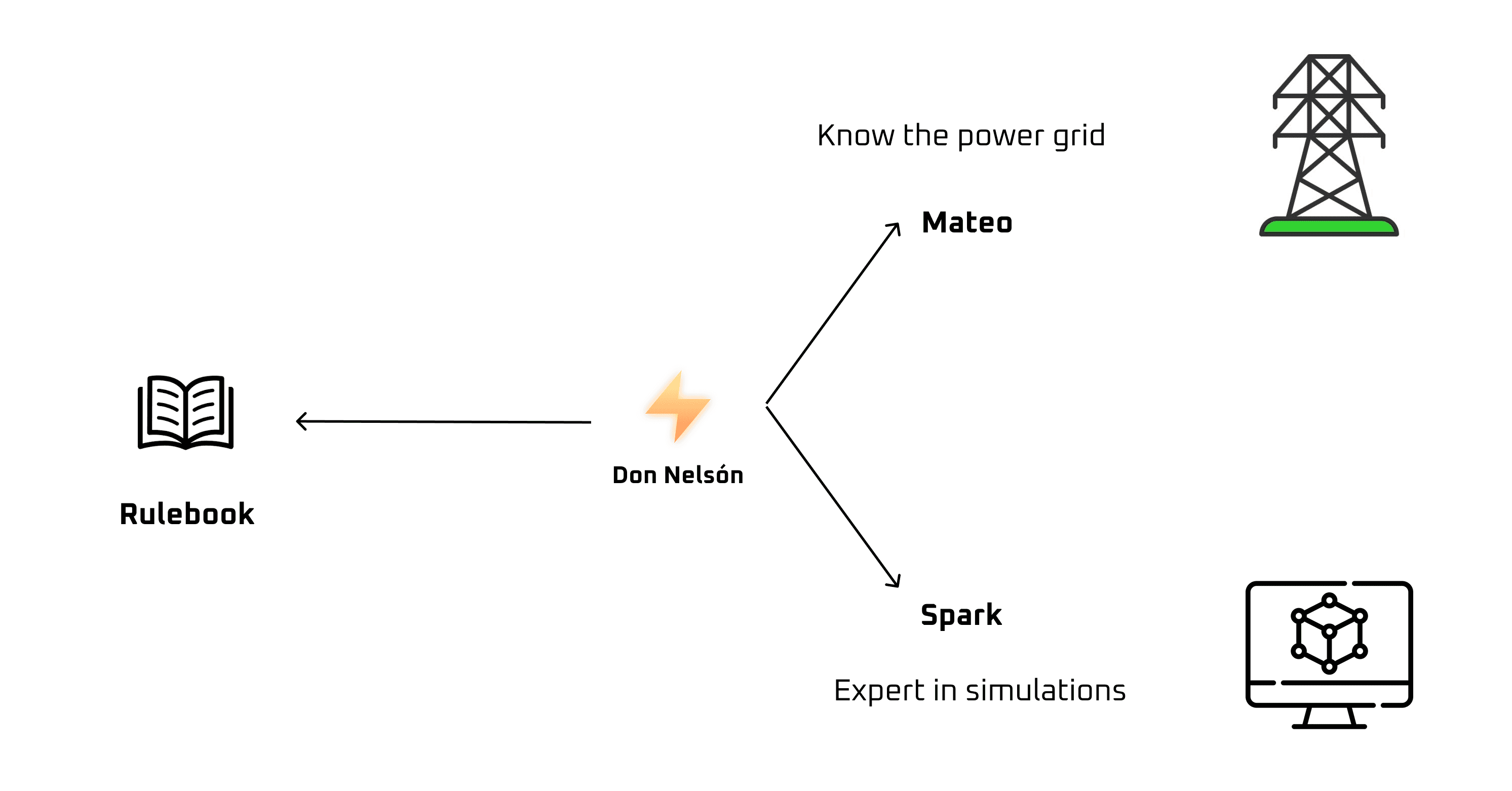
For Don Nelson to review a Power Flow Study, I tell it what a reviewer actually checks: what they look at, what they verify, what they contrast it against.
The checklist isn't the criterion
Chile's grid operator publishes review checklists for power flow and short-circuit studies, and the PGP user guide describes the procedure. I read them cover to cover. They tell you what gets delivered — "Report delivered", "PowerFactory database delivered" — and almost nothing about what gets flagged.
Between "the study shall correctly model the equipment" and "the line's zero-sequence impedance doesn't match the manufacturer datasheet" there is an enormous gap. That gap is the reviewer's job.
The criterion does exist, but it lives in two places: in the heads of people who have been reviewing for years, and — this is what saved me — in the review documents the operator issues study by study. Every observation is a rule applied, with the concrete case attached. I don't know what gets reviewed because someone wrote it down: I know it because I know what gets flagged.
Where I got it
I built a corpus from the CEN's reviews of power flow studies: 223 studies, 571 review iterations and 1,797 items — 1,180 observations, 640 considerations and 11 recommendations — snapshotted on May 20, 2026.
And something that wasn't in the original plan: the third-party observations. The companies that own the connection point review in parallel, and turned out to be as tough a source as the operator itself.
The pipeline is unglamorous: download the review PDFs, extract the text, split it item by item, and classify each item with a model along four axes — type (observation / consideration / recommendation), category, severity and required action (fix, clarify, verify, add case, update data, redo). Then group the items that say the same thing in different words and keep the rule underneath.
That's the whole funnel: 2,168 real observations reducing to 1,468 codable checks and from there to 48 unique rules. Forty-eight. That's what you need to know to review a power flow study in Chile.
What the corpus says
Before the rules, three things that changed how I think about this.
First: only 15.9% of studies pass clean. The rest come back with observations or considerations. The median review takes 24 days.
How many rounds a study takes to close
Bars: studies that closed in that many rounds. Line: average observations raised in that round. It drops sharply, but never reaches zero.
Second: 82.8% of studies get third-party observations. The connection point owner reviews with a magnifying glass, and flags different things than the operator. They know their own installation better than anyone, and they notice when the model doesn't represent it.
The operator and the third party don't look at the same things
% of each reviewer's observations falling in that category. The connection point owner hits twice as hard on incomplete documents and nearly three times on inconsistent models.
Third, and the one that surprised me most: what gets flagged most isn't hard engineering. It's incorrect input data, with 297 items. More than line overload, unmet N-1 criterion and out-of-range voltage drop combined.
What gets flagged, by volume
1,797 items across 571 review iterations. The top three aren't grid problems — they're data and document problems.
Almost none of what gets flagged is the power system behaving badly. It's the number in the report not matching the number in the official source.
A reviewer doesn't review "the study". They review consistency across sources.
The rules that carry the weight
Of the 48, these eight explain most of the volume. I'm writing them the way an engineer would say them, not the way the standard does:
- 1
That equipment parameters — length, R, X, B, zero sequence, taps, ratings — match InfoTécnica and the manufacturer datasheets exactly.
frequency in the corpus: 256
- 2
That the declared transmission capacity accounts for the actually limiting series element: not the conductor, but the CT, the wave trap, the disconnector or the bay jumper.
frequency in the corpus: 132
- 3
That names, voltages, identifiers and units are the same in the text, the tables, the single-line diagrams and the database.
frequency in the corpus: 122
- 4
That the Minimum Scenario Letter is followed to the letter: every case, every condition, none missing and none invented.
frequency in the corpus: 90
- 5
That the schedule and in-service date are coherent with the third-party works the study assumes to exist.
frequency in the corpus: 62
- 6
That mitigation measures are quantified and simulated, not merely stated.
frequency in the corpus: 59
- 7
That the delivered database converges, runs, and actually contains the configured study cases.
frequency in the corpus: 50
- 8
That the modelled topology is the real one: breakers, couplings and outages as they are in the field, not as they are in the diagram.
frequency in the corpus: 38
Notice the pattern. Six of the eight are verifiable against an external source: InfoTécnica, the manufacturer datasheet, the Scenario Letter, the works schedule, the simulation database itself. Almost none of them need engineering judgment to detect — judgment comes afterwards, to decide how serious it is.
From rules to harness capabilities
The 48 rules aren't implemented one by one. They cluster into six capabilities, and each capability carries a weight: how many real observations from the corpus it would have caught.
How much each harness capability weighs
How many real observations from the corpus that capability would have caught.
That weight is what turns the corpus into an engineering tool: the agent's coverage stops being declared and starts being measured. I can say what share of the CEN's real observations Don Nelson would have caught with what's already built — validating parameters against InfoTécnica, cross-checking the Scenario Letter — and what share depends on re-simulating in PowerFactory, which is Spark's job.
What's missing gets measured too. Document consistency and database version are still out of Don Nelson's reach, and now I know exactly what they cost: 274 real observations that would slip by today.
The 48 rules
Here they all are, grouped by the capability that covers them. It's public knowledge distilled from public documents, so there's not much point in keeping it to myself:
Validate parameters against InfoTécnica
8 rules · weight 488- 1That equipment parameters match InfoTécnica and the manufacturer datasheets×256critical
- 2That transmission capacity accounts for what actually limits it: series elements, switchyard equipment or protections×132critical
- 3That technical prerequisites are approved, with official single-line diagrams and a unique ID (NUP) per piece of equipment×29critical
- 4That local generation, distributed generation and busbar demands are justified and properly modelled×24medium
- 5That reactive and dynamic compensation (PPC, SVC, STATCOM, BESS) is modelled with its parameters and control modes×23critical
- 6That boundary conditions, outages and local physical limitations are in the model×11critical
- 7That demand in the area of influence is properly characterised and projected over time×8medium
- 8That tap changers (LTC/NLTC) and transformer taps are modelled and actually operable×5critical
Re-simulate in PowerFactory
15 rules · weight 336- 9That mitigation measures are defined, quantified, simulated and feasible×59critical
- 10That the simulation database converges, runs without errors and is complete and well configured×50critical
- 11That the topology and the real state of breakers, couplings and outages are represented×38critical
- 12That automatic schemes (EDAG/ERAG/EDAC) and islanding are modelled, justified and specified×34critical
- 13That it's clear which overloads already existed, which ones the project brings and how much they weigh×27critical
- 14That the dispatch limits and curtailment needed to meet N-1 are defined×27critical
- 15That sensitivities get simulated: extreme demand, outages and unusual topologies×21critical
- 16That BESS are modelled with their operating modes, charge/discharge limits and constraints×18critical
- 17That renewable dispatch by time block is physically and temporally consistent×16critical
- 18That operational control schemes, network splits and degraded operation are defined×16medium
- 19That busbar contingencies account for real physical coupling and transformer loss at connection substations×10critical
- 20That contingencies are simulated with automatic schemes, protections and load transfers acting×10critical
- 21That admissible transient overload, thermal constants and the risk of protections tripping are analysed×4medium
- 22That after fixing the model, simulations are re-run and results updated×4medium
- 23That Strategic Reserve plants are out of service in the model×2critical
Document consistency
8 rules · weight 247- 24That the document is well written: formatting, consistent units and correct labelling×122minor
- 25That result tables include every variable and every element they should×33medium
- 26That results, dispatch and operating states in the report match the database×30critical
- 27That single-line diagrams have enough detail, with section lengths and geographic context×18medium
- 28That previous observations are answered traceably and actually incorporated×16critical
- 29That conclusions, overload alerts and mitigations say the same thing as the simulations×13critical
- 30That switching sequences, construction stages and transient commissioning topologies are analysed×9critical
- 31That critical contingencies are compared with and without the project×6medium
Cross-check the Scenario Letter
10 rules · weight 233- 32That the Minimum Scenario Letter (CEM/CEMD) is followed to the letter×90critical
- 33That the schedule and in-service date match the third-party works the study assumes×62critical
- 34That contingencies are complete and traceable between reports and simulation files×37critical
- 35That N-1 covers the whole area of influence and the congested corridors×13critical
- 36That the model is complete and the area of influence well delimited×10critical
- 37That the no-project Base Case (Case 0) is there for comparison×9critical
- 38That the system is checked under extreme contingencies and maintenance conditions (N-1-1)×4critical
- 39That losing the largest generating unit or its radial evacuation line is studied×3critical
- 40That critical contingencies are also checked in transition scenarios and temporary topologies×3medium
- 41That there's a sensitivity for third-party system works arriving late×2critical
Check NTSyCS limits
6 rules · weight 99- 42That transmission capacity is sensitised to ambient temperature and weather×40critical
- 43That voltage limits hold under N-1, with voltage control and load shedding schemes×32critical
- 44That power transformer loading and parallel operation have technical backing×11critical
- 45That admissible overload limits under N-1 are respected×7critical
- 46That reference voltages and per-unit bases are up to date and the same across the study×5medium
- 47That N-0 loading leaves room to meet N-1 in parallel circuits×4critical
Database version
1 rules · weight 27- 48That the simulation database is the current one, compatible and traceable×27critical
×n = frequency in the corpus (operator observations + third-party observations, the latter weighted double). Severity is what the classifier assigned when grouping the items.
Being honest about it
The 48 rules are my synthesis, not an official document: nobody published this and nobody is going to validate it. They're built from the public checklists, the applicable regulation and the observation history; the corpus runs through May 2026 and covers power flow — short-circuit is another pass. Each item was classified by a model, with manual spot-checking, so the categories carry noise.
Even so, it's the best I have, and it's infinitely better than the alternative — which was asking the agent to review a study using instructions I wrote from memory. The harness now carries an answer key that can be checked against reality: every time Don Nelson raises a finding, there's a corpus of 2,168 real observations to ask whether a human reviewer would have raised it too.
That, in the end, is all a good harness does: turn knowledge that lived in someone's head into something you can run, measure and correct.