The agent starts to understand Chile's electrical system
Day 51 / 60
Many days without writing. I finished the Google DeepMind hackathon (35,000 registered, I think it's impossible to win) on Monday, so yesterday I took a more relaxed day.
Smarter agent
I've been working on making the agent genuinely more capable, not just adding tools but improving how it thinks and decides.
The planner now generates sub-steps within each DAG task. Before, each graph node was a general instruction; now it breaks down into more granular steps, giving the agent more clarity about what to do at each moment.
I added map evaluation and document selection. The agent can now look at a single-line diagram or a geospatial map and decide on its own what information is relevant before moving forward. This is key because before it had to process everything, now it filters.
I also implemented quick acknowledgment: when you give it an instruction, the agent confirms it understood before starting to execute. Seems minor but it greatly improves the experience — you know it understood what you asked before it starts running simulations for 20 minutes.
Lastly, unnecessary VM skipping. The agent now evaluates whether it actually needs to spin up a virtual machine with DIgSILENT for the task or if it can solve it without simulation. Each VM costs money and time, so this significantly optimizes costs.
Expanded Infotecnica
I discovered that Infotecnica has a REST API. Until now the agent was just navigating the website clicking around and reading modals. Now it queries the API directly, which is much faster and more reliable.
But the most important thing is that now I can read all of Infotecnica. Before the agent could only search for substations. Now it supports 22 types of installations from the Chilean electrical system and can list the entire SEN via the API. Power plants, transmission lines, substations, PMGD, everything. This completely changes the scope of what the agent can do in terms of searching and analyzing the system.
New features
I added an email sending tool. Now I can launch the agent to work for minutes/hours and when it finishes it notifies me by email. The idea is to take it further: have it send me a progress update every X tasks, so I can leave it running without having to watch.
Example of what the agent can do
Current prompt:
I need a complete analysis of the electrical transmission infrastructure in southern Chile. Do the following:
1. Inventory by company: List all Transelec substations, then CGE Transmision's, and finally Saesa's in the SEN. For each company, tell me how many substations they have and summarize the voltage levels they handle.
2. Valdivia area analysis: Search all electrical infrastructure within a 50 km radius around Valdivia. Include power plants, substations, transmission lines and energy storage. Identify which are the main substations feeding the city.
3. Technical detail of key substations: For the "Valdivia" and "Ciruelos" substations, get their complete technical specifications. Also list the available documents for each and analyze their single-line diagrams to identify: voltage levels, number of bays, power transformers and their capacities.
4. Infrastructure map: Generate a satellite map centered on Valdivia showing all electrical infrastructure within a 40 km radius. Highlight the Valdivia and Ciruelos substations.
5. Transmission lines: List all 220 kV and 66 kV transmission lines in the SEN belonging to Transelec. For those connecting to the Valdivia area, get their technical specifications.
6. Nearby generation plants: Search infrastructure within a 100 km radius around Valdivia, filtering only generation plants. Identify those with the highest capacity and classify them by energy type (hydro, wind, solar, thermal).
7. Executive summary: With all the collected information, write an executive summary of the electrical infrastructure situation in the Valdivia area, including strengths, weaknesses and points of interest. Send the summary to [email protected] with the subject "Valdivia Area Electrical Infrastructure Analysis".
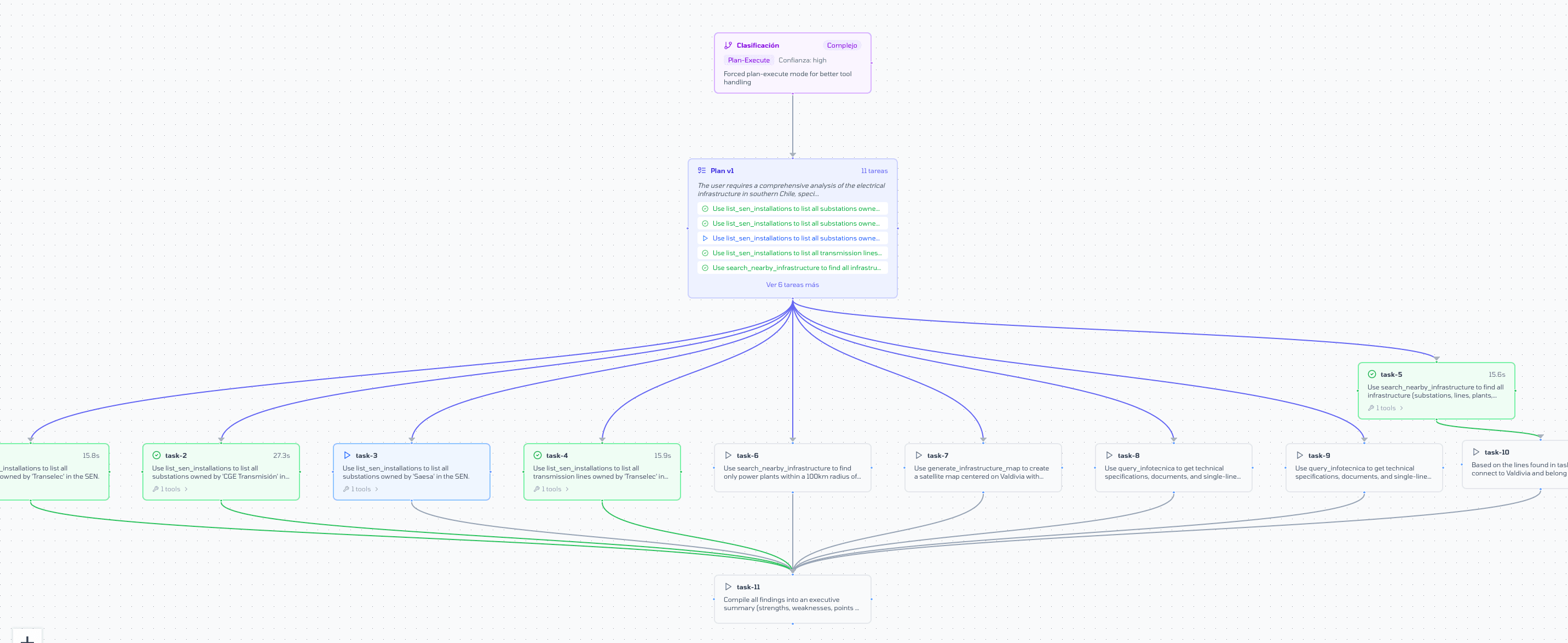
Plan v1 generated by the agent
The agent built the plan, distributed the tasks across the DAG, and executed everything autonomously. Infotecnica API queries, geospatial searches, single-line diagram analysis, map generation, and in the end I received an email with the executive summary. No manual intervention.
This is exactly what I want D.N. to do: receive a complex requirement, decompose it, execute it and deliver results. The interesting thing is that a few weeks ago this wasn't possible.
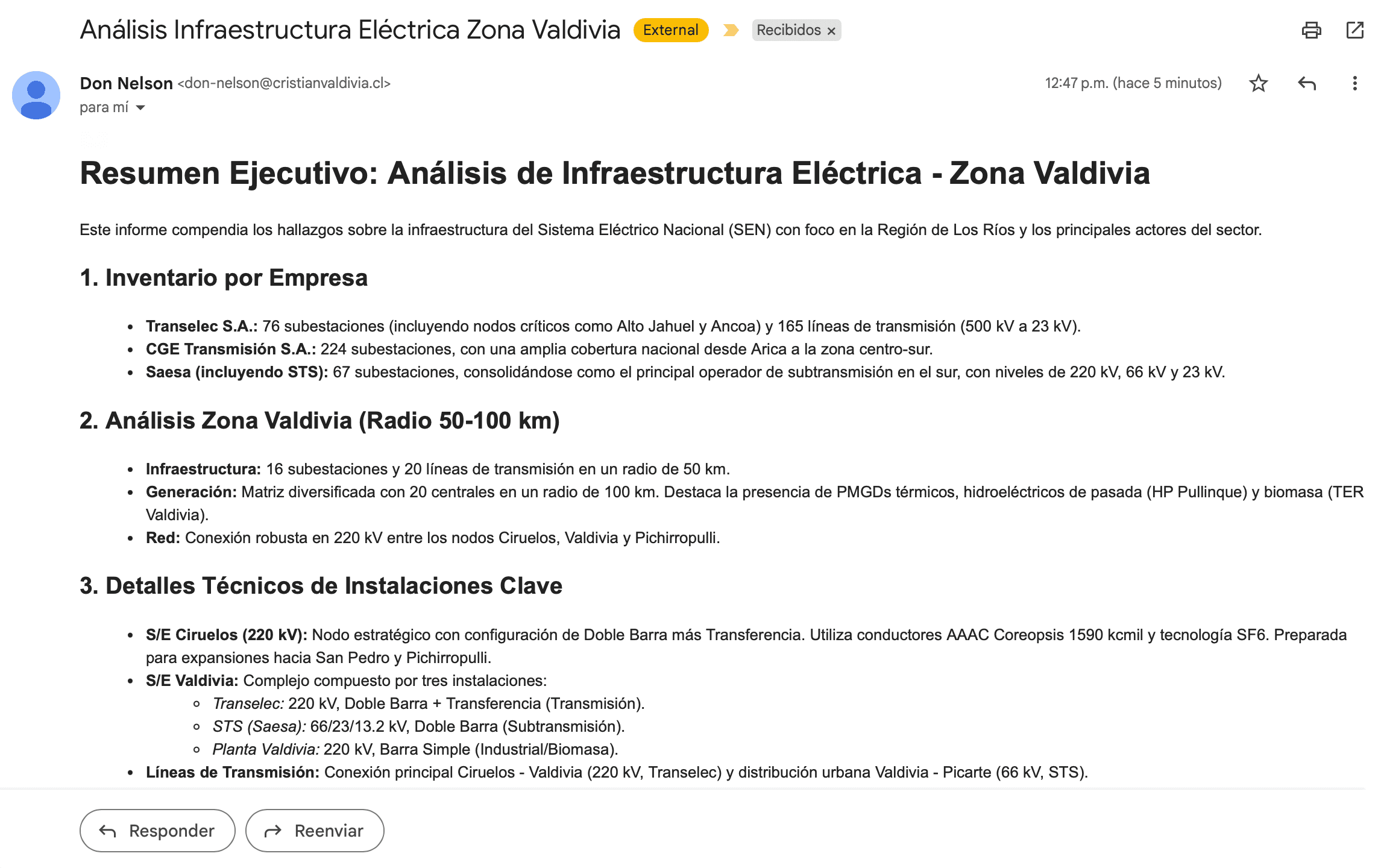
Email received with the executive summary
What's coming
The Moltys project — these agents that work as personal assistants — gave me several feature ideas I want to implement. Particularly in memory and autonomy, which is where I need to advance the most. Today the agent executes well what you ask, but I want it to remember context between sessions and make more independent decisions without needing such explicit instructions.
And something important: I'm preparing everything for a public release. I've been in meetings with potential clients and have several interested parties, so as soon as my 60-day challenge ends I'm going to start commercializing the agent.
If you want to get an email when I publish new content, subscribe below.