Open access: teaching the agent how projects connect to the SEN
Day 52 / 60
In the previous post the agent started to understand the Chilean electrical system. Now it needs to understand how projects connect to that system.
In the Infotecnica post I mentioned that the next task was to go to open access. The time has come.
(I have a particular fondness for Open Access — many of my colleagues and friends started their careers as electrical engineers in this department at the CEN)
What is open access
For those unfamiliar: open access is the right that any person or company has to connect to the transmission facilities of the National Electrical System, as determined by the National Electrical Coordinator (CEN). It's regulated by articles 79 and 80 of the General Law of Electrical Services.
In practical terms, if you want to connect a solar farm, a wind plant, any generation project to the SEN or a datacenter, you have to go through the open access process. It's the mandatory path.
There are three main types of requests:
- SAC (Connection Authorization Request): to connect to public service transmission facilities, meaning national and zonal transmission.
- SUCTD (Available Technical Capacity Use Request): to connect to dedicated transmission facilities.
- Proyectos facientes (related projects): own installations or projects seeking to connect to facilities belonging to the same company.
The CEN has an open access platform where you can track all ongoing requests. It's public.
Why D.N. needs this
Until now the agent can perform power flow studies, short circuits and protection coordination. It can go to Infotecnica and extract technical data from substations. It can search for substations near a geographic location.
But it's missing a critical piece: knowing what's in the connection process.
Imagine the agent identifies that the S/E Carrera Pinto has three available positions on the 220 kV bus. Perfect. But if there are 2 solar projects already approved waiting to connect, those positions aren't really available. Without checking open access, the agent would be recommending incorrect connection points.
For a real connection study, you need to cross-reference at least four information sources:
- Infotecnica: what physically exists at the substation
- Open access: what projects are in the process of connecting
- CNE: the projects in the Expansion plan (I'll go into more detail about this tomorrow)
- The CEN grid model: how the system behaves electrically
The agent already handles (1) and (4). I'm finishing (2) and will look at (3) tomorrow.
Scraping the open access platform
The CEN's open access platform is more structured than Infotecnica. The information is organized by requests, each with its status, connection point, power and dates.
I'm building a tool that allows the agent to:
- Search active requests by connection point (substation)
- Filter by status (in process, approved, under construction)
- Extract the power and estimated connection date
- Identify if there are restrictions or special conditions
Unlike Infotecnica, where the main challenge was interpreting visually complex single-line diagrams, here the challenge is more about structured data.
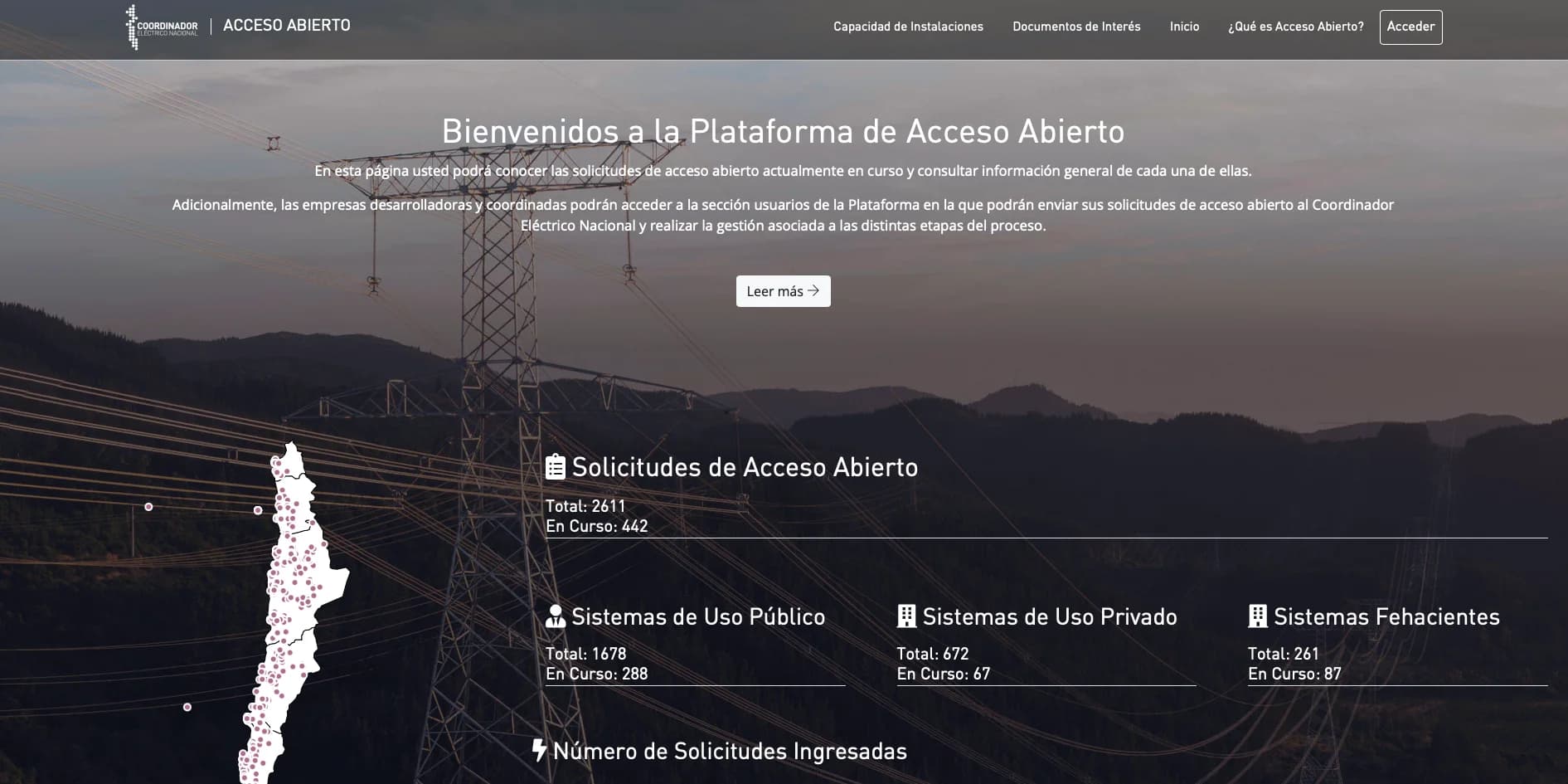
CEN open access platform
I knew this would happen but it's still surprising: the number of projects in the queue. There are substations with dozens of active requests. Northern Chile, especially, has a brutal concentration of solar projects in the connection process. When I saw the data from some substations in Atacama I was left thinking about how complex it is to plan the system expansion with this amount of generation.
The technical capacity problem
This is where things get interesting for the agent.
It's not enough to know that there's a physical position available at a substation. You need to verify that the system can absorb the power injection without violating thermal, voltage or stability limits. That's exactly what the studies that D.N. already knows how to perform are for.
The ideal flow would be:
- The user says: "I want to connect a 50 MW solar farm near Copiapo"
- The agent searches nearby substations (geospatial tool)
- For each substation, queries Infotecnica (technical data)
- Queries open access (what's in process)
- With all that information, configures the grid model in PowerFactory
- Runs the power flow and short circuit studies
- Generates the report
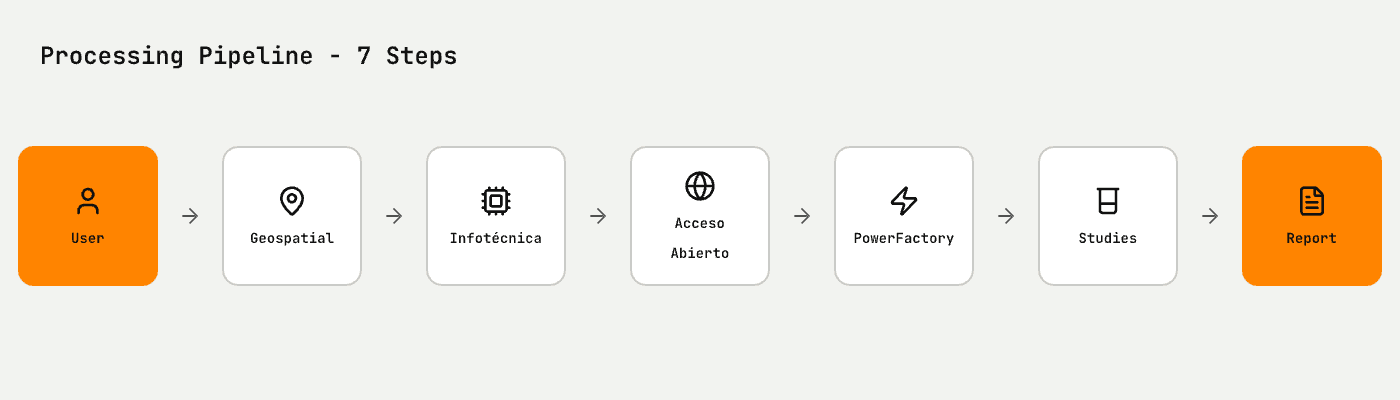
Processing pipeline - 7 steps
But in practice, steps 2, 3 and 4 are independent of each other. The agent can query the three data sources in parallel and then converge in PowerFactory:
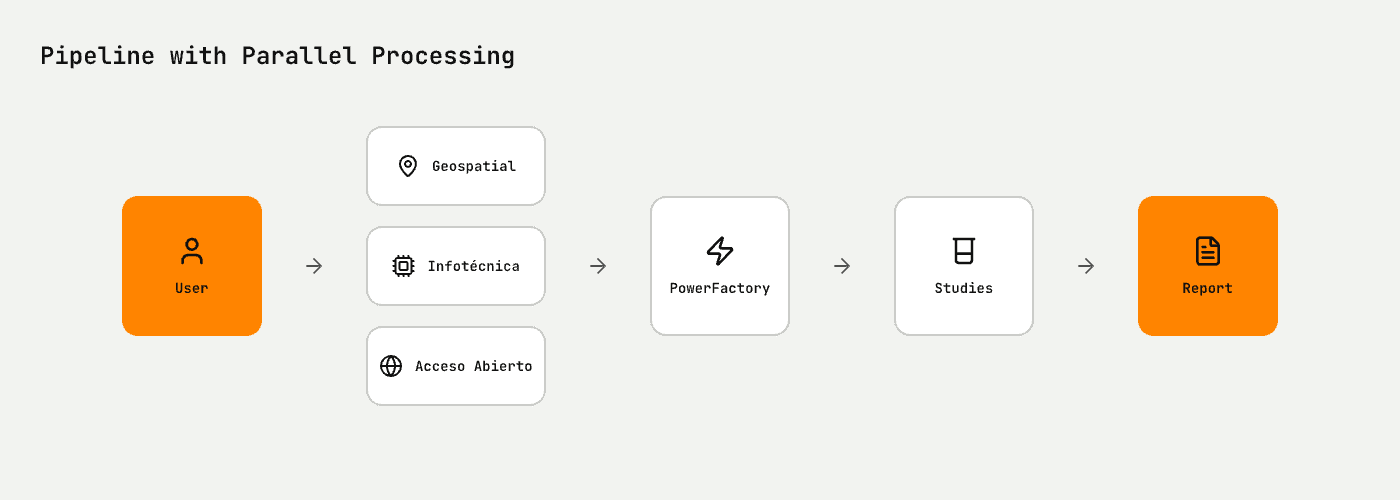
Pipeline with parallel processing
I feel closer and closer to a complete study.
Current state and what's left
The open access tool is functional but rough. The agent can query requests by substation and get a summary of the situation. It's not yet integrated with the full study flow.
What I still need for the remaining days:
- Finish the Open Access tools.
- Have the agent reason about the actual available capacity by cross-referencing all sources.
- Improve reports to include information about projects in the queue.
- Add CNE data: projects declared under construction and the Transmission Expansion Plan. Open access tells you who requested to connect, but the CNE tells you which of those projects are actually moving forward and what new transmission works are coming. That's for the next post.
Reflection
Every time I add a new data source to the agent, I notice the same thing: the difficulty isn't in getting the data, but in cross-referencing it with judgment. An experienced engineer knows that an "available" position in Infotecnica might not actually be available if open access shows 5 projects in the queue. That kind of reasoning is exactly what I'm trying to get the agent to do.
What's interesting is that by giving it the tools to access the information, the agent already starts making connections I didn't explicitly tell it to. I say "evaluate this connection point" and it decides on its own to query both Infotecnica and open access. Not because I tell it to, but because it understands it needs both sources for a complete answer.
That confirms the approach is correct. I don't teach it to do electrical studies. I give it the tools and the context. The judgment emerges from the model's intelligence.
If you want to get an email when I publish new content, subscribe below.